
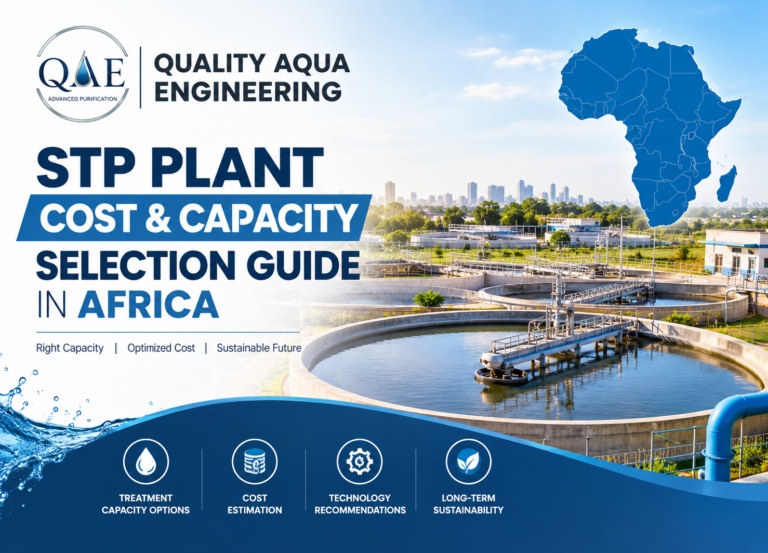
Choosing the right Sewage Treatment Plant (STP) is essential for residential buildings, hotels, hospitals, commercial complexes, industries, and infrastructure projects across Africa. With growing urbanization and increasing wastewater generation, effective sewage treatment has become important for protecting the environment, maintaining hygiene, and supporting sustainable water management. However, selecting an STP plant requires careful consideration of installation costs, treatment capacity, wastewater characteristics, available space, and local discharge regulations. An undersized plant may fail to handle wastewater loads, while an oversized system can increase capital and operating expenses. Quality Aqua Engineering provides sewage treatment solutions designed around project requirements, wastewater flow, treatment standards, and available infrastructure. Whether you need a compact STP for a commercial property or a large-capacity system for a residential or industrial development, understanding the cost and capacity requirements can help you make an informed investment decision.
Get the Right STP Solution for Your Project in Africa
📞 Call / WhatsApp: +91-8802928500
Get FREE Water Testing & Best Price Quote for your STP plant project.
Why Do Projects in Africa Need an Efficient STP Plant?
Sewage contains organic matter, suspended solids, detergents, microorganisms, and other contaminants that can harm the environment if discharged without adequate treatment. Residential communities, hotels, hospitals, educational institutions, shopping centres, and industrial facilities generate wastewater every day.
In many African regions, growing populations and expanding commercial infrastructure are increasing the need for reliable wastewater treatment systems. Untreated sewage can contaminate groundwater, rivers, and other water sources, creating environmental and public health concerns.
Common wastewater management challenges include:
- Inadequate sewage treatment: Older or poorly designed systems may not achieve the required treatment quality.
- Increasing wastewater volumes: Expanding facilities may exceed the capacity of existing treatment plants.
- Limited installation space: Urban developments often require compact, efficient treatment systems.
- High operating expenses: Incorrect equipment selection can increase electricity consumption and maintenance costs.
- Changing project requirements: Future occupancy and facility expansion can increase wastewater generation.
A properly designed STP helps manage these challenges by treating sewage before discharge or reuse, subject to applicable local standards.
How to Select the Right STP Plant Capacity
Capacity selection is one of the most important steps when planning a sewage treatment plant in Africa. The plant should accommodate the expected daily wastewater flow while accounting for peak loads and future expansion.
1. Calculate Daily Wastewater Generation
Estimate the number of people using the facility and the wastewater generated per person each day. Actual generation varies according to the type of building, water consumption, occupancy, and local conditions.
For preliminary planning, consider this illustrative example:
- Number of occupants: 500
- Assumed water consumption: 135 litres per person per day
- Assumed wastewater generation: 80% of water consumption
Estimated wastewater generation:
500 × 135 × 80% = 54,000 litres per day, or 54 KLD.
KLD means kilolitres per day. One KLD equals 1,000 litres per day.
This calculation is only an initial estimate. A qualified engineer should verify the actual wastewater flow, peak loading, infiltration, and applicable design requirements before finalizing capacity.
2. Consider the Type of Facility
Different facilities produce different wastewater volumes and pollutant loads. A residential apartment complex may have predictable daily flows, whereas a hotel may experience significant variations during peak occupancy.
Consider these factors:
- Residential occupancy and the number of apartments.
- Hotel room occupancy, kitchens, and laundry facilities.
- Hospital operations and wastewater characteristics.
- Commercial building occupancy and toilet usage.
- Industrial processes that may require separate pretreatment.
3. Plan for Future Expansion
If your project is expected to expand, consider future occupancy and additional wastewater generation. Modular treatment systems can sometimes allow capacity expansion without replacing the entire plant.
4. Evaluate Operating Conditions
Water availability, electricity reliability, temperature, operator skills, maintenance access, and the availability of replacement components can affect plant performance. These factors should be evaluated alongside treatment capacity.
Need help selecting the correct STP capacity in Africa?
📞 Call / WhatsApp: +91-8802928500
Quality Aqua Engineering can help assess your project requirements and recommend a suitable sewage treatment solution.
Types of STP Plants Available for Projects in Africa
The right treatment technology depends on wastewater quality, site conditions, required effluent standards, budget, and operating capabilities.
1. MBBR Sewage Treatment Plant
A Moving Bed Biofilm Reactor (MBBR) uses specially designed media that support microbial growth to treat organic pollutants. It can provide a compact treatment solution and is suitable for several residential and commercial applications.
2. SBR Sewage Treatment Plant
A Sequencing Batch Reactor (SBR) performs treatment processes in a timed sequence within a reactor. It can offer operational flexibility and may be suitable for projects with varying wastewater flows when properly designed.
3. MBR Sewage Treatment Plant
A Membrane Bioreactor (MBR) combines biological treatment with membrane filtration. It can produce high-quality treated water and support water reuse applications, although membrane cleaning, replacement, and operating costs require careful consideration.
4. Conventional Activated Sludge Process
This technology uses biological treatment followed by solids separation. It can be appropriate for larger projects where sufficient space, suitable operating expertise, and maintenance resources are available.
5. Packaged or Compact STP
Packaged plants integrate treatment equipment into a compact configuration. They may be suitable for hotels, commercial buildings, residential developments, and facilities with limited installation space.
Technology selection should be based on engineering requirements rather than purchase price alone.
STP Plant Cost in Africa: Estimated Price Guide
The cost of an STP plant in Africa depends on capacity, technology, construction requirements, equipment specifications, transportation, installation location, and commissioning arrangements. Import duties, taxes, local civil works, and installation services can also affect the final project budget.
The following figures are illustrative preliminary budgeting ranges in Indian rupees (INR), not verified supplier quotations or confirmed Africa-market prices.
| STP Capacity | Illustrative Budget Range |
|---|---|
| 10 KLD | ₹5–10 lakh |
| 25 KLD | ₹8–18 lakh |
| 50 KLD | ₹12–30 lakh |
| 100 KLD | ₹20–45 lakh |
| 250 KLD | ₹40–90 lakh |
| 500 KLD | ₹70 lakh–₹1.5 crore |
| 1,000 KLD | ₹1.2–3 crore or more |
Actual costs can fall outside these ranges depending on project specifications. International freight, customs duties, local construction, taxes, and country-specific compliance costs may be additional.
What Affects STP Installation Cost?
- Treatment capacity: Larger plants generally require more equipment and infrastructure.
- Technology: MBBR, SBR, MBR, and conventional systems have different equipment and operating requirements.
- Civil construction: Underground tanks, foundations, buildings, and site preparation influence the budget.
- Automation: Control panels, monitoring instruments, and automation can change initial costs.
- Installation and commissioning: Labour, transportation, testing, and operator training may be charged separately.
- Operation and maintenance: Electricity, chemicals, sludge handling, spare parts, and periodic servicing affect lifecycle costs.
Always request a detailed quotation specifying the scope of supply, exclusions, warranty, commissioning, and expected operating costs.
Why Choose Quality Aqua Engineering for STP Projects in Africa?
Quality Aqua Engineering provides water and wastewater treatment solutions tailored to project requirements. Selecting an experienced treatment provider helps ensure that plant capacity, technology, equipment, and operating needs are evaluated before implementation.
Site Inspection Before Quotation
A proper site assessment helps identify available space, wastewater collection arrangements, existing infrastructure, installation constraints, and discharge or reuse requirements. Remote project assessments may be used initially, with on-site inspections arranged according to project location and scope.
Customized Capacity-Based Solutions
Every project has different wastewater volumes and treatment objectives. Quality Aqua Engineering can help assess the required capacity and suitable technology for residential, commercial, institutional, and industrial applications.
After-Sales Support and Maintenance
Regular maintenance is essential for reliable plant operation. Support requirements may include preventive maintenance, equipment checks, troubleshooting, spare-parts planning, and operator guidance, depending on the agreed service scope and project location.
Project-Specific Guidance
From preliminary capacity assessment to equipment selection and commissioning planning, a project-specific approach helps customers evaluate installation requirements and budget considerations.
Discuss your STP project with Quality Aqua Engineering.
📞 Call / WhatsApp: +91-8802928500
Get expert guidance on capacity selection, technology options, and project costing.
Frequently Asked Questions About STP Plants in Africa
1. What is the cost of an STP plant in Africa?
The cost depends on capacity, technology, equipment specifications, installation requirements, and the country where the plant will be installed. A site-specific quotation is necessary to determine the actual project cost.
2. How do I calculate the required STP capacity?
Estimate the daily wastewater generated by occupants or operations, then assess peak flows, wastewater characteristics, and future expansion. A qualified engineer should validate the final design capacity.
3. Which STP technology is best for African projects?
MBBR, SBR, MBR, and conventional activated sludge systems can all be suitable in different circumstances. The best option depends on land availability, effluent quality requirements, budget, operating expertise, and maintenance resources.
4. Can treated STP water be reused?
Yes. Properly treated wastewater may be reused for applications such as landscaping, toilet flushing, or other suitable non-potable purposes when it meets the relevant quality standards and local regulations. Additional filtration or disinfection may be required.
5. Does Quality Aqua Engineering provide STP solutions for projects in Africa?
Quality Aqua Engineering can discuss project requirements, suitable treatment options, capacity planning, and quotation requirements for African projects. Confirm shipping, installation, commissioning, and after-sales service availability for your specific country before placing an order.
Still confused about STP plant capacity or cost?
📞 Call / WhatsApp: +91-8802928500 for expert guidance.
Get the Best STP Plant Solution in Africa
Facing sewage treatment challenges? Don’t wait until wastewater management becomes a bigger operational or environmental problem.
Choose an STP solution that matches your wastewater volume, treatment requirements, available space, and long-term operating budget. Quality Aqua Engineering can help you evaluate the options and plan your project requirements.
📞 Call / WhatsApp: +91-8802928500
📞 Alternate Contact: +91-9350809193
🌐 Visit: https://qualityaquaengineering.com/
✉️ Email: info@qualityaquaengineering.com
Address: 249A, Pocket-12, DDA Flats, Jasola Vihar, New Delhi – 110025, India.
Fill in the enquiry form below to request:
- Free initial consultation
- Project-specific price quotation
- Site inspection planning
- STP capacity and technology guidance
Take the first step toward efficient wastewater treatment with a solution planned around your project needs.
Contact Quality Aqua Engineering today to discuss your STP plant project in Africa.