
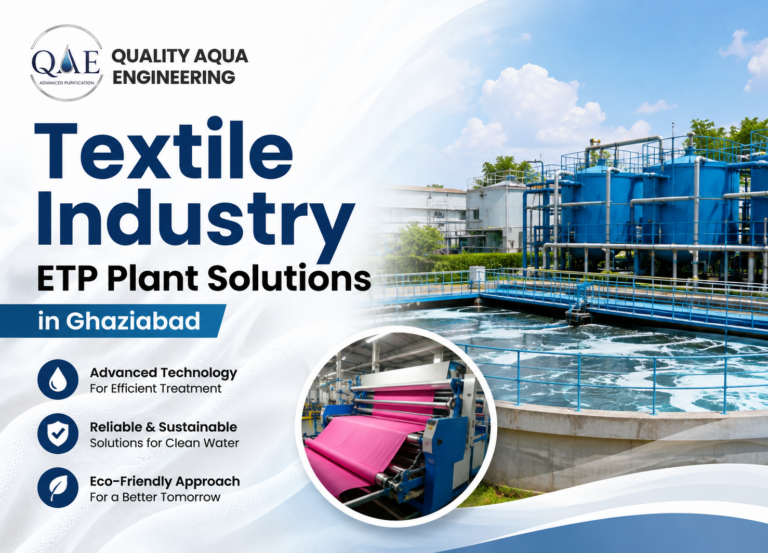
The textile industry uses large quantities of water for dyeing, washing, bleaching, printing, finishing, and other manufacturing processes. As a result, textile units in Ghaziabad generate wastewater containing dyes, chemicals, suspended solids, oils, organic matter, and other pollutants. If this wastewater is discharged without proper treatment, it can create serious environmental and compliance challenges.
For textile manufacturers looking for reliable Textile Industry ETP Plant Solutions in Ghaziabad, a properly designed Effluent Treatment Plant (ETP) is essential. Quality Aqua Engineering provides customized industrial wastewater treatment solutions designed according to wastewater characteristics, flow rate, treatment requirements, and available space. With professional design, installation, testing, and after-sales support, businesses can achieve effective effluent treatment and improve water management.
📞 Get FREE Water Testing & Best Price Quote in Ghaziabad
Call / WhatsApp: 8802928500
Get expert guidance, wastewater testing, site inspection, and a customized ETP proposal for your textile manufacturing facility.
Why Textile Industries in Ghaziabad Need an ETP Plant
Textile manufacturing wastewater can be difficult to treat because its characteristics vary according to the production process and chemicals used. Dyeing and finishing operations may produce highly colored wastewater, while washing and processing can increase suspended solids, organic load, pH variation, and chemical concentration.
Some common challenges faced by textile industries include:
- High Chemical Oxygen Demand (COD)
- High Biochemical Oxygen Demand (BOD)
- Suspended solids and sludge
- Strong wastewater coloration
- Variable pH levels
- Chemicals from dyes and processing agents
- Oil and grease in certain wastewater streams
- Large quantities of wastewater
- Increasing water and wastewater management costs
- Environmental compliance requirements
A properly engineered Textile Industry ETP Plant in Ghaziabad helps industries treat wastewater before safe discharge or further reuse. The right system can also support water conservation and reduce the environmental impact of textile operations.
Advanced Textile Industry ETP Plant Solutions
An ETP is designed to remove pollutants from industrial wastewater through a combination of physical, chemical, and biological treatment processes. Since every textile unit generates wastewater with different characteristics, the ETP should be designed after understanding the actual effluent quality and daily flow.
Quality Aqua Engineering provides customized ETP solutions based on site conditions, wastewater analysis, production capacity, and treatment objectives.
A typical textile ETP may include:
- Collection & Equalization Tank – Collects wastewater and helps balance variations in flow and pollutant concentration.
- Screening System – Removes larger solids and floating materials.
- Oil & Grease Removal – Helps separate oils and grease where required.
- pH Correction – Maintains wastewater within the required pH range for subsequent treatment.
- Coagulation & Flocculation – Helps remove suspended particles, color, and certain dissolved pollutants.
- Primary Clarifier – Separates chemically treated solids from wastewater.
- Biological Treatment – Reduces biodegradable organic matter such as BOD and COD.
- Secondary Clarifier – Separates biological sludge from treated water.
- Tertiary Treatment – Additional filtration and polishing can be provided according to reuse or discharge requirements.
- Sludge Handling System – Collects and manages sludge generated during the treatment process.
The exact configuration depends on wastewater testing and the required treated water quality.
📞 Need an ETP for Your Textile Unit?
Call / WhatsApp: 8802928500
Get FREE Water Testing & Best Price Quote
Our team can assess your wastewater, inspect your site, understand your production process, and recommend a suitable treatment configuration.
Types of ETP Solutions for Textile Industries
Different textile facilities require different treatment approaches. Some commonly considered solutions include:
1. Conventional Textile ETP
A conventional ETP combines physical, chemical, and biological treatment processes. It is suitable for many textile manufacturing applications where wastewater contains a mixture of suspended solids, organic pollutants, chemicals, and color.
2. Chemical Treatment ETP
Chemical treatment can be particularly useful for wastewater containing high color, suspended solids, and difficult-to-biodegrade pollutants. Coagulation, flocculation, pH correction, and clarification may be incorporated.
3. Biological ETP
Biological treatment uses microorganisms to reduce biodegradable organic pollutants. It can be integrated with primary and tertiary treatment for improved overall performance.
4. MBBR-Based ETP
Moving Bed Biofilm Reactor (MBBR) technology uses specialized media to support microbial growth. It can provide efficient biological treatment within a relatively compact footprint and may be suitable for industries with space constraints.
5. ETP with Tertiary Treatment
Where higher-quality treated water is required, tertiary treatment such as pressure sand filtration, activated carbon filtration, ultrafiltration, or other polishing processes can be incorporated.
6. ETP for Water Reuse
Textile units interested in reducing freshwater consumption can consider treatment systems designed to produce water suitable for selected reuse applications. The required treatment level depends on the intended reuse purpose.
Textile ETP Plant Price in Ghaziabad
The cost of a textile industry ETP plant depends on several factors, including wastewater flow, pollutant concentration, treatment technology, automation, civil work, equipment selection, and the required treated water quality.
| ETP Capacity | Approx. Price Range* |
|---|---|
| 10 KLD | ₹5–8 Lakh |
| 25 KLD | ₹8–13 Lakh |
| 50 KLD | ₹12–20 Lakh |
| 100 KLD | ₹20–35 Lakh |
| 200 KLD | ₹35–55 Lakh |
| 500 KLD | ₹60 Lakh–₹1 Crore+ |
*These are indicative ranges only. The actual Textile Industry ETP Plant price in Ghaziabad can vary according to wastewater characteristics, technology, equipment specifications, automation, civil requirements, and installation conditions. A site inspection and wastewater analysis are recommended before receiving a final quotation.
Why Choose Quality Aqua Engineering in Ghaziabad?
Choosing the right ETP manufacturer is important for achieving consistent wastewater treatment performance and reliable operation. Quality Aqua Engineering focuses on customized industrial wastewater treatment solutions rather than using a one-size-fits-all approach.
Site Inspection Before Quotation
Our team can evaluate the textile facility, available installation area, wastewater collection points, production process, and other site conditions before recommending the system.
Customized Capacity-Based Solution
ETP capacity is selected according to wastewater generation and operational requirements. Treatment stages can also be customized according to wastewater quality and discharge or reuse objectives.
Professional Engineering & Installation
A properly designed treatment system helps ensure that equipment works together effectively. Our solutions can include equipment selection, plant installation, commissioning, and operational guidance.
After-Sales Support & Maintenance
Regular maintenance is essential for long-term ETP performance. Support can include inspection, troubleshooting, equipment maintenance, and guidance for plant operation.
Solutions for Ghaziabad Industries
With a focus on industrial wastewater treatment, Quality Aqua Engineering can provide solutions for textile units and other industries operating in Ghaziabad and nearby Delhi NCR areas.
Frequently Asked Questions
1. What is a Textile Industry ETP Plant?
A Textile Industry ETP Plant is an Effluent Treatment Plant designed to treat wastewater generated during textile processes such as dyeing, washing, bleaching, printing, and finishing.
2. How is the capacity of a textile ETP decided?
ETP capacity is generally determined according to the quantity of wastewater generated by the facility. Production capacity, operating hours, water consumption, and wastewater flow should be considered before finalizing the plant capacity.
3. Can an ETP remove color from textile wastewater?
Yes. Depending on the type and concentration of color, suitable chemical, physical, biological, and tertiary treatment processes can be incorporated to reduce wastewater color.
4. What is the price of a Textile ETP Plant in Ghaziabad?
The price depends on capacity, wastewater characteristics, treatment technology, automation, equipment specifications, civil work, and installation requirements. A site inspection and wastewater analysis are recommended for an accurate quotation.
5. Can treated textile wastewater be reused?
Yes, treated wastewater may be considered for selected reuse applications when the treatment system is designed to achieve the required water quality. Additional tertiary treatment or advanced filtration may be necessary depending on the intended use.
Still confused?
📞 Call / WhatsApp: 8802928500 for expert guidance.
Get the Best Textile Industry ETP Plant Solutions in Ghaziabad
Facing textile wastewater treatment challenges? Don’t wait.
📞 Call / WhatsApp: 8802928500
🌐 Visit: qualityaquaengineering.com
👇 Fill the enquiry form below for:
✔ Free consultation
✔ Best price
✔ Site inspection
✔ Wastewater testing
✔ Customized ETP solution
Contact Details – Quality Aqua Engineering
Address:
249A, Pocket-12, DDA Flats, Jasola Vihar, New Delhi – 110025
Contact Us:
Support: +91-8802928500
Call/WhatsApp: +91-9350809193
Email: info@qualityaquaengineering.com
Learn More:
Website: www.qualityaquaengineering.com
Happy Clients: www.qualityaquaengineering.com/clients.php
Quality Aqua Engineering can help textile industries evaluate their wastewater treatment requirements and select an appropriately designed ETP solution for their facility in Ghaziabad and the surrounding Delhi NCR region.